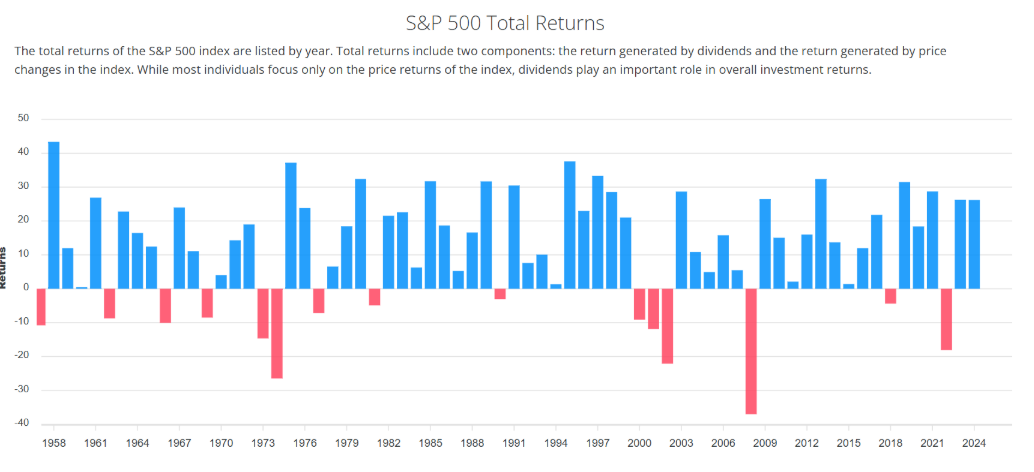
The S&P 500 has long been a cornerstone of many investment strategies, with an average annual return of just over 10% since its inception in 1957. It represents a diversified mix of 500 of the largest U.S. companies, making it a popular choice for investors seeking growth. So, with such a strong track record, why not just put your entire portfolio into the S&P 500? While this approach may seem appealing, it’s important to understand that past performance is not a guarantee of future returns, and relying on one asset class may not always align with your financial goals.

Volatility and Market Cycles
The S&P 500, while historically strong, is not immune to significant market volatility. Economic cycles, geopolitical events, and unforeseen crises can lead to major downturns. For example, in 2008, during the global financial crisis, the S&P 500 experienced a max drawdown of -37%, and even the best years, like 1995, saw remarkable gains of 34.11%. However, the market doesn’t always provide such stellar returns. If you were to pull your investment during a downturn, you could lock in losses that may take years to recover. This is particularly risky if you need access to liquidity or income generation in the short run. While the S&P 500 has rebounded over the long term, short-term market fluctuations can severely affect your ability to meet immediate financial needs or short-term goals.
Sector and U.S. Economic Exposure
Investing solely in the S&P 500 also exposes you to the risks inherent in a U.S.-focused index. The S&P 500 only represents the largest companies within the U.S., limiting your exposure to global opportunities. If the U.S. economy experiences a recession or slower growth, your entire portfolio would be at risk. Additionally, the S&P 500 is heavily concentrated in certain sectors, particularly technology. As of 2023, more than 25% of the index’s market cap is dominated by tech companies like Apple, Microsoft, and Nvidia. If there’s a downturn in the tech sector, whether from regulatory changes or other factors, the S&P 500’s performance could suffer, even if other sectors like energy, healthcare, or consumer goods are doing well. This lack of sector diversification makes the index vulnerable to shifts in specific industries, which could be detrimental if one sector faces a slowdown.
Lack of Flexibility and Tailored Risk Management
The S&P 500 is designed to reflect the performance of the U.S. equity market but doesn’t account for your specific financial situation, investment goals, or risk tolerance. For instance, if you’re looking for stable income generation in retirement, the S&P 500’s relatively low dividend yield (around 1.5-2%) may not provide enough cash flow. Additionally, if you’re targeting growth in emerging markets, private equity, or sectors like real estate, biotech, or green energy, the S&P 500 won’t provide exposure to those areas. Without diversifying into other asset classes, you may miss opportunities that align more closely with your financial objectives and higher-growth sectors or investments that may offer greater potential for returns.
Missed Opportunities and Behavioral Biases
Investing solely in the S&P 500 limits your portfolio’s potential by excluding other asset classes like international equities, real estate, or commodities. These asset classes often behave differently from U.S. equities, providing valuable diversification benefits and potentially reducing overall risk. Moreover, behavioral biases can distort your decision-making. The S&P 500’s historical performance may lead to overconfidence, causing you to ignore other investment opportunities. On the flip side, fear-based panic selling during periods of poor performance may result in missing out on the eventual recovery.
Change in Market Dynamics
The composition of the S&P 500 is constantly evolving, but there’s no guarantee that the sectors driving its success today will continue to do so in the future. The tech sector has been a significant driver of the index’s growth, but a slowdown in technology—due to market saturation, regulatory changes, or technological shifts—could weigh heavily on the index. Meanwhile, newer sectors like renewable energy, electric vehicles, or emerging market economies may provide greater growth potentialbut are underrepresented in the S&P 500. By sticking only to the index, you risk missing out on these high-growth areas that could outperform traditional sectors.
Conclusion
While the S&P 500 has historically provided solid returns, its volatility, market concentration, and lack of global exposure make it unwise to invest your entire portfolio in the index. A well-diversified strategy that includes fixed income, private placements, small, mid, and large-cap stocks, and international equities can help reduce risk and position your portfolio for long-term success.
At Ceva Advisors, we specialize in creating customized investment strategies that balance growth, stability, and risk management to help you achieve your financial goals. Contact us today to discover how we can help you build a diversified portfolio that aligns with your goals.
The information contained in this report is informational and intended solely to provide educational content to our clients and other readers that we find relevant and interesting. Opinions expressed are just that, and are current only as of the data of publication Nothing in this document should be construed as investment advice; we provide advice on an individualized basis only after understanding your circumstances and needs. Information provided comes from sources we believe are reliable, but accuracy is not guaranteed. Past performance is not a guarantee of future returns.