
Welcome to the October 2024 edition of Ceva Insights – your monthly briefing on the latest financial developments. This month, market participants experienced increased volatility driven by significant moves in the 10-year Treasury yields and shifting expectations around Federal Reserve actions. In this issue, we’ll explore key trends in the economy, equities, fixed income, and the real estate market.
Key Highlights: Navigating October of 2024
Economic Overview: October 2024’s economic landscape showed resilience with a GDP revision to 3.0%, steady inflation, and heightened volatility due to the upcoming election and Fed meeting.
Equities: The S&P 500 fell 0.9% amid inflation pressures, while the Russell 2000 gained 0.7% on a mid-month recovery, but closed down 1.49% for the month. Goldman Sachs trimmed 10 year expectations to 3% growth year-over-year.
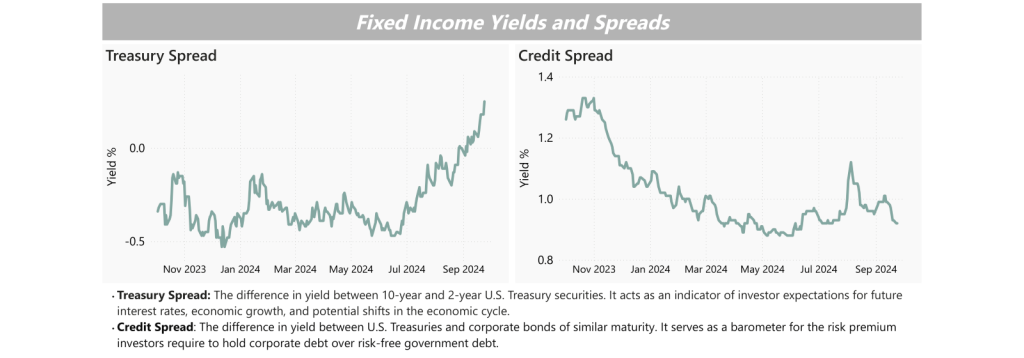
Fixed Income: The 10-year Treasury yield rose to 4.28%, signaling inflation concerns. Treasury spreads widened, reflecting growth expectations, while credit spreads tightened by month-end on improved sentiment.
Real Estate: Rising mortgage rates, up from 6.09% to 6.72%, have slowed the market, with inventory up 29.2% year-over-year. Private placements remain attractive for their diversification and uncorrelated performance.
Economic Overview
October 2024 presented a dynamic economic landscape, shaped by a mix of strong growth signals and inflationary pressures. The U.S. real GDP for Q2 was revised upward to 3.0%, underscoring economic resilience. Meanwhile, core CPI remained steady at 0.2%, suggesting potential easing of inflationary pressures. The upcoming election is contributing to heightened uncertainty, with investors positioning for increased market volatility. Adding to this, the Federal Reserve’s upcoming meeting on November 7th could further impact markets, as investors brace for potential shifts in monetary policy. Together, these events make November a month to watch for heightened volatility and rapid market reactions.
GDP Growth: Revised up to 3.0% for Q2, indicating stronger-than-expected momentum.
Inflation: Core CPI held steady at 0.2%, hinting at stable inflation trends.
Election & Fed Impact: The upcoming election and Fed meeting on November 7th are expected to increase market volatility as investors prepare for potential policy shifts.
Equities
Equity markets in October 2024 faced mixed results as investors navigated heightened volatility and fluctuating economic data. The S&P 500 declined by 0.9% this month, ending a six-month winning streak as big tech underperformed amid inflation pressures. However, Goldman Sachs remains optimistic, projecting a 10% gain for equities by year-end and a 3% year-over-year growth.
Small-cap stocks, represented by the Russell 2000, showed resilience mid-month, but ended up closing down 1.49% by the end of October. Bitcoin also saw notable activity, with increased interest attributed to speculative “Trump trade” dynamics and broader market uncertainty.
S&P 500: Down 0.9% as tech and inflation pressures weighed on the index.
Goldman Sachs Forecast: Additional growth expected over the next year but projections of 3% year-over-year growth over the next 10 years for the S&P 500.
Small Caps: Russell 2000 up 0.7% in a mid-month recovery but finished the month down by 1.49%.
Bitcoin: Increased volatility as speculative trades gained traction.

Fixed Income
October 2024 brought a challenging environment for the fixed income market, with bond yields experiencing significant increases. The 10-year Treasury yield rose from 3.8% at the start of the month to 4.28% by the end, reflecting market expectations for inflationary pressures and fewer rate cuts. Treasury spreads widened, signaling optimism about growth but potential headwinds for bond performance if inflation accelerates under anticipated fiscal policies.
Credit spreads initially widened due to early economic concerns but later tightened as sentiment improved following steady economic data. The upcoming election is expected to impact fixed income strategies, with bond markets bracing for potential fiscal expansion under either a Trump or Harris administration.
10-Year Treasury Yield: Rose from 3.8% to 4.28%, indicating inflation concerns.
Treasury Spreads: Widened, reflecting growth expectations but potential inflationary risks.
Credit Spreads: Widened early but tightened by month-end, reflecting improved sentiment.
Real Estate Focus
In October 2024, the residential real estate market remained resilient despite rising mortgage rates. The average 30-year fixed mortgage rate in the U.S. climbed from 6.09% to 6.72% since the Federal Reserve’s 0.5% rate cut on September 18th, reflecting that broader interest rates don’t always move in sync with Fed actions. Inventory levels increased 29.2% year-over-year, the highest since December 2019, while demand for smaller, affordable homes remained steady with a 2.1% rise in price per square foot. Homes spent an average of 58 days on the market, signaling a more deliberate pace as buyers adjust to higher financing costs.
Inventory Growth: Active listings up 29.2% year-over-year.
Mortgage Rates: Average 30-year fixed rate increased from 6.09% to 6.72%.
Price Trends: Median home price steady at $424,950; price per square foot up by 2.1%.
Market Pace: Homes on the market for an average of 58 days.
Private Placements: Remain attractive for uncorrelated performance, offering diversification and potential for excess returns.
Closing Remarks
October 2024 underscored the importance of adaptability in an environment shaped by economic resilience, central bank actions, and heightened political dynamics. As we look toward November, both the upcoming election on the 5th and the Federal Reserve meeting on November 7th are expected to bring additional volatility, with potential shifts in policy that could impact markets significantly. In light of these events, maintaining a diversified strategy will be key for navigating potential opportunities and risks.
We’ll continue to monitor these developments closely and provide you with insights to help you make informed decisions. Thank you for joining us in this month’s review, and we look forward to keeping you updated in the months ahead.
Allen, Henry and Jim Reid. “October 2024 Performance Review.” Deutsche Bank Research, November 1, 2024
Goodman, David. “5 Things You Need to Know to Start Your Day: October 1 – October 31, 2024 Series.” Bloomberg, October 1 – October 31, 2024.
IMPORTANT DISCLOSURE: The information contained in this report is informational and intended solely to provide educational content to our clients and other readers that we find relevant and interesting. Opinions expressed are just that, and are current only as of the data of publication Nothing in this document should be construed as investment advice; we provide advice on an individualized basis only after understanding your circumstances and needs. The information presented in this newsletter is based on reports from Deutsche Bank and Bloomberg’s ‘5 Things You Need to Know to Start Your Day’ series. Data provided comes from sources we believe are reliable, but accuracy is not guaranteed. Discussion of sectors and the performance of region-specific equities and bonds generally refers to market indices. We use the S&P 500 to represent US large-cap; the Willshire Small Cap to represent US small-cap; the MSCI ACWI ex US to represent international equities; the US 10-year Treasury Yield to represent US Treasuries; the ICE BofA European Government Bond Index to represent European bonds; the ICE BofA US Corporate Index Effective Yield to represent investment-grade bonds; the ICE BofA US High Yield Index Effective Yield to represent high-yield bonds. Indices are unmanaged, are not subject to investment management fees or transaction costs, and it is not possible to invest in an index. Index performance can provide general information about how a particular region or investment has performed, but does not provide information about the performance of Ceva’s client portfolios. Actual client performance may differ materially from the index performance discussed. Past performance is not a guarantee of future results. Financial planning is a tool that can help clients consider different current and future scenarios and construct portfolios designed to meet specific goals and address specific risks. Financial planning does not guarantee a positive outcome or prevent loss. It’s important to revisit financial plans and the underlying assumptions of those plans regularly, and to make adjustments as needed to respond to changing circumstances.